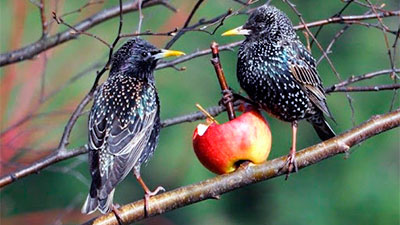
Grackles and crows share striking similarities with their all-black plumage, dark legs and beaks, and iridescent feathers that shimmer with purple, blue, or green highlights. Both species exhibit remarkable intelligence, form large communal roosts numbering in the thousands, and display bold, sometimes aggressive behavior around food sources and nesting territories.
However, these birds belong to entirely different families and have considerable differences that make identification straightforward with a closer look. Crows are generally much larger and heavier than grackles, have a distinctive “caw” vocalization that’s unmistakable once learned, and are found on nearly every continent worldwide. Grackles, by contrast, are exclusively New World birds with long, keel-shaped tails and bright yellow eyes in most species.
Read on to discover the distinctive differences in taxonomy, physical appearance, vocalizations, behavior, breeding patterns, intelligence, and geographic distribution between these two frequently confused species. Understanding these 12 key differences will help you confidently identify grackles and crows in the field.
Grackle Vs. Crow – Quick Reference Overview
This comprehensive comparison table provides at-a-glance differentiation between grackles and crows across all major characteristics. According to Cornell Lab of Ornithology, grackles are “large, lanky blackbirds with long legs and long tails” that are “taller and longer-tailed than a typical blackbird,” making size and proportion key identification features.
| Characteristic | Grackle | Crow |
|---|---|---|
| Taxonomy |
|
|
| Color & Iridescence |
|
|
| Eye Color |
|
|
| Size & Weight |
|
|
| Tail Shape |
|
|
| Vocalizations |
|
|
| Preening Behavior |
|
|
| Group Behavior |
|
|
| Breeding Pairs |
|
|
| Nesting & Eggs |
|
|
| Migration & Distribution |
|
|
| Intelligence Examples |
|
|
12 Differences Between Grackles & Crows

Let’s examine these factors in detail to understand what makes grackles and crows distinct from each other.
1. Taxonomy: Different Bird Families
Grackles and crows belong to completely different families, making them only distantly related despite their superficial similarities.
Grackles (Family Icteridae): There are 11 known species of grackles (one is extinct), all belonging to the family Icteridae and genus Quiscalus. The Common Grackle is the most widespread species, found throughout eastern and central North America. Other members of the Icteridae family include orioles, meadowlarks, and cowbirds—all New World species with diverse appearances and ecological niches.
Crows (Family Corvidae): There are approximately 40 species of crows worldwide, belonging to the family Corvidae and genus Corvus. The Corvidae family also includes ravens, jackdaws, jays, and magpies—birds renowned for their intelligence and complex social behaviors. The American Crow (Corvus brachyrhynchos) is the most familiar species in North America.
Key Takeaway: The family-level difference means grackles are more closely related to orioles than to crows, while crows are more closely related to jays and ravens than to grackles. This fundamental taxonomic distinction underlies many of the physical and behavioral differences between these birds.
2. Color & Iridescence Patterns
While both birds appear all black from a distance, their plumage reveals distinctly different iridescent colors when viewed in good light.
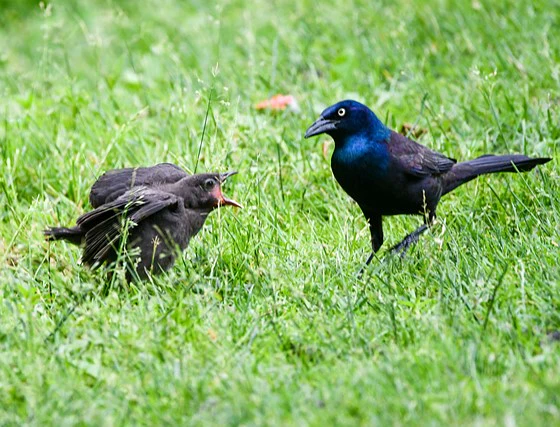
Grackles: According to Cornell Lab, “Common Grackles appear black from a distance, but up close their glossy purple heads contrast with bronzy-iridescent bodies.” Male grackles display spectacular iridescence in bronze, green, and purple hues that vary by subspecies and viewing angle. The “bronzed grackle” race shows characteristic bronzy backs, while the “Florida grackle” appears darker green rather than bronzy. Female grackles are similar in color but noticeably duller and less glossy. Juvenile grackles are pale brown overall.
Crows: Most crow species are uniformly black with an iridescent blue or blue-green sheen visible in sunlight. Unlike grackles, female crows are identical in color to males, showing no sexual dimorphism in plumage. Male crows may have slightly larger head crests, but color remains consistent. Juvenile crows have fluffier, non-iridescent feathers that lack the glossy sheen of adults.
Quick Identification Tips:
- Blue-green sheen = crow
- Bronze/purple/green sheen with contrasting head = grackle
- Pale brown bird = juvenile grackle (not crow)
3. Eye Color: The Golden Giveaway

Eye color provides one of the most reliable field marks for distinguishing these species.
Grackles: Adult Common Grackles are characterized by “a bright golden eye [that] gives grackles an intent expression.” Most grackle species have striking yellow or golden eyes that create a piercing, intense look. Some species, like the Boat-tailed Grackle, show geographic variation—with bright yellow eyes along the Atlantic Coast and dull brownish eyes along the western Gulf Coast. Juvenile grackles have black or brown eyes that transition to yellow as they mature.
Crows: Adult crows have entirely black eyes that blend seamlessly with their black facial feathers, making the eye less prominent than in grackles. Juvenile crows, interestingly, have blue eyes that darken to black as they mature.
Field Identification Shortcut: If you can see bright yellow or golden eyes, you’re looking at a grackle (assuming it’s an adult). Black eyes indicate a crow or juvenile grackle. This single feature alone can confirm identification when other field marks are difficult to observe.
4. Size & Weight: Crows Are Much Larger
Size represents one of the most obvious differences once you know what to look for.
Grackles: Cornell Lab describes Common Grackles as “about the same size as a Mourning Dove”—a helpful comparison for field identification. Grackles range from 11 to 13 inches in length with a wingspan of 14 to 18 inches. They weigh between 2.6 to 5 ounces (74-142 grams). Grackles show pronounced sexual dimorphism, with males significantly larger than females.
Crows: Crows are substantially larger, ranging from 14 to 22 inches long with wingspans of 15 to 59 inches (varies considerably by species). American Crows typically measure around 17-21 inches. They weigh between 11.2 to 22.4 ounces (316-635 grams)—approximately 2 to 4 times heavier than grackles. Males are only slightly larger than females, showing minimal sexual dimorphism.
When seen side by side, the size difference is dramatic. Even when observed separately, crows appear noticeably bulkier and more substantial, while grackles are described as “large, lanky blackbirds” with a slimmer, more elegant profile.
5. Tail Shape: Keel Versus Fan
Tail shape and length provide excellent identification features, especially when birds are in flight or perched.
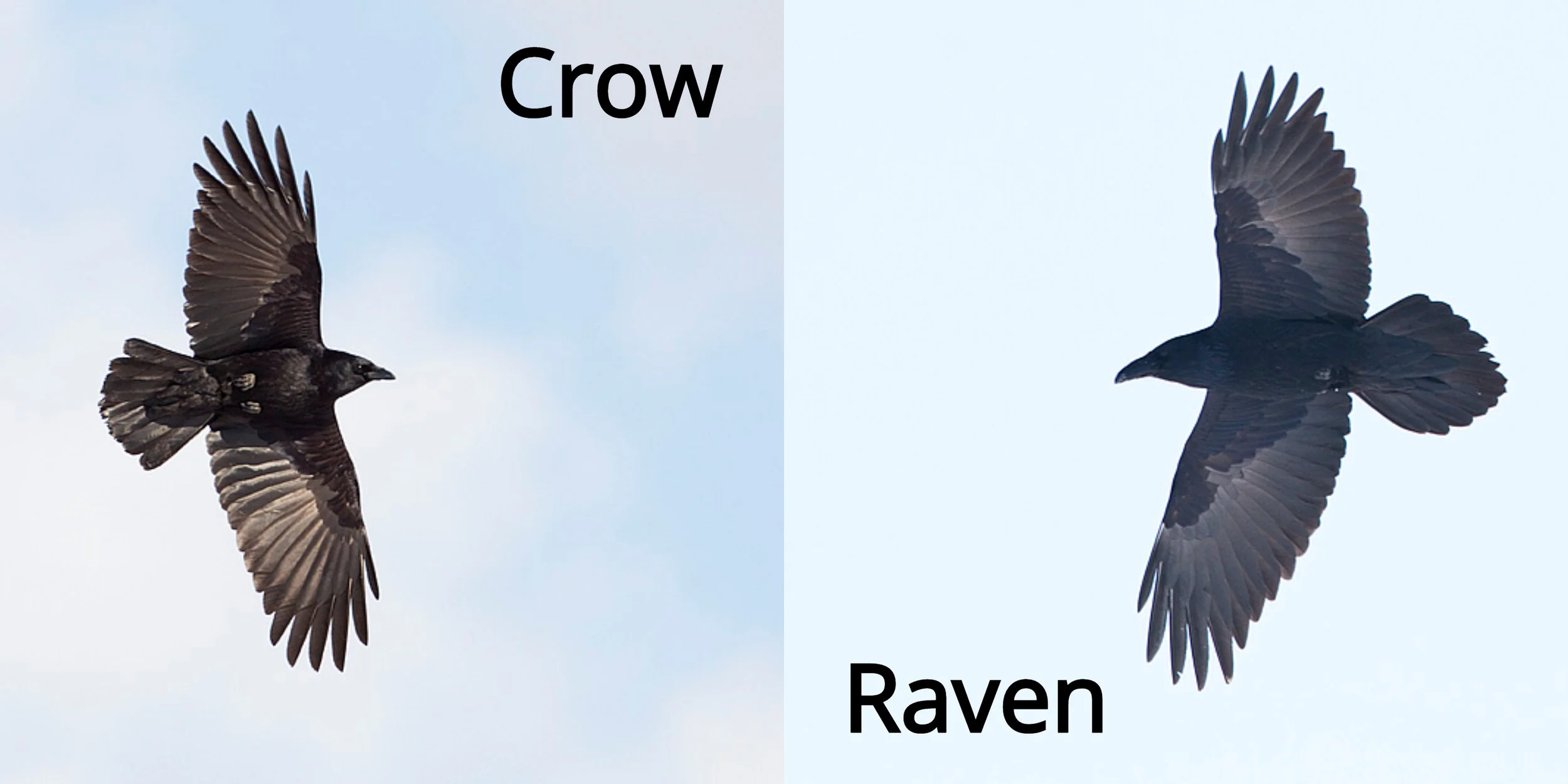
Grackles: Grackles possess extraordinarily long tails that are nearly as long as their entire body. Great-tailed Grackles have tails “nearly as long as [the] body and [that fold] into a distinctive V or keel shape.” This V-shaped or keel-shaped profile resembles the keel of a boat, creating a characteristic silhouette. When grackles fly overhead, you can observe an orange or russet patch on the underside of the tail—a unique field mark. The long tail often trails conspicuously behind the bird in flight.
Crows: Crow tails are proportionally much shorter than their bodies, typically measuring 5 to 7.5 inches long. When spread during flight or landing, crow tails form a rounded fan shape with a square or slightly rounded tip. The tail appears less prominent in the bird’s overall silhouette compared to the grackle’s dramatic tail.
6. Vocalizations: Rusty Gates Versus Caws
Once you learn these birds’ distinctive vocalizations, identification by sound becomes nearly foolproof.
Crows: Crows produce the familiar, unmistakable “caw caw caw” that most people can recognize. This harsh, nasal call is one of the most recognizable bird sounds in North America. Crows also produce harsh screeches, rattles, and a variety of other vocalizations. Female caws tend to be softer and higher-pitched than male calls. When crows repeat multiple caws in rapid succession, they often signal danger, communicate territorial boundaries, or alert the flock to threats.
Grackles: Grackles produce a much wider range of sounds including squeaks, whistles, harsh croaks, and mechanical-sounding calls. Males and females produce a characteristic guttural, creaking sound combined with high-pitched whistling. Each note typically lasts about one second and is commonly described as sounding like a “rusty gate” or “squeaky hinge.” Boat-tailed Grackles “clack or scream at predators” and produce varied chattering, whimpering, and rattling sounds.
Sound Identification:
- “Caw caw caw” = definitely a crow
- Rusty gate, squeaky, mechanical sounds = grackle
- Grackles have more varied repertoires; crows have more consistent calls
7. Preening Behavior: Anting Frequency
Both species engage in interesting preening behaviors, but with notable differences in frequency and methodology.
Grackles: According to Cornell Lab, “You might see a Common Grackle hunched over on the ground, wings spread, letting ants crawl over its body and feathers. This is called anting, and grackles are frequent practitioners among the many bird species that do it.” Ants secrete formic acid that may help rid birds of parasites. Remarkably, grackles have been observed using diverse substances for anting including walnut juice, lemons, limes, marigold blossoms, chokecherries, and even mothballs. Grackles primarily preen themselves rather than engaging in mutual preening.
Crows: Crows occasionally practice anting but less frequently than grackles. A distinguishing feature of crow social behavior is mutual preening between mated pairs. One crow stretches out its neck in an invitation, and the partner methodically preens individual feathers, working from the back of the head toward the front. This social bonding behavior reinforces their lifelong pair bonds.
8. Group Behavior: Flock Size and Funerals
Both species are highly social, but their flocking patterns and group behaviors differ significantly.
Grackles: Cornell Lab notes that “Common Grackles are large, noisy, and gregarious birds that often flock with other blackbirds, cowbirds, and starlings, especially in winter.” Grackles typically forage and travel in groups of 10 to 30 pairs, though flocks can swell to 100 or more birds. They commonly roost communally in enormous numbers—thousands of birds gathering in favored trees or structures. Common Grackles sometimes nest in loose colonies of up to 200 pairs, showing little territoriality except immediately around individual nests.
Crows: Crows generally flock in smaller family groups of 2 to 8 pairs during the day, though they also roost communally in massive numbers—creating the famous “murder of crows” gatherings of thousands. One of the most fascinating crow behaviors is their practice of holding “funerals.” When a crow finds a dead crow, it calls out to alert others. Crows gather around the deceased bird and create a ruckus with loud vocalizations. Researchers believe this behavior serves to identify and remember locations and circumstances of danger, helping the flock avoid similar threats in the future.
9. Breeding Pairs: Seasonal Versus Lifelong Bonds
The pair-bonding strategies of these species represent fundamentally different reproductive approaches.
Grackles: Grackles are seasonally monogamous, forming breeding pairs that typically last for only one breeding season. Pairs may change partners between years, and some species show patterns of serial monogamy. This breeding strategy allows for genetic diversity and flexibility in mate selection based on territory quality and individual fitness.
Crows: Crows form strong, lifelong monogamous pair bonds. Mated crow pairs typically stay together year-round, maintaining their partnership through multiple breeding seasons until one partner dies. This long-term bonding strategy enables cooperative territory defense, accumulated breeding experience, and coordinated offspring care. While crows are socially monogamous, genetic studies have revealed some promiscuity occurs in certain populations—meaning social pairs remain together while occasional extra-pair mating happens.
10. Nesting & Eggs: Habitat and Clutch Differences
Both species build cup-shaped nests in trees, but their site selection and egg characteristics differ.
Grackles: The female grackle “typically” selects nest sites “high in a coniferous tree between two vertical limbs or on a horizontal branch,” though nests have been recorded “as low as 8 inches off the ground and in deciduous vegetation, cattails and other sites.” Grackle nests are commonly located 4 to 20 feet high and typically built near water sources. Nests measure 6 to 9 inches across and 3 to 9 inches deep. Females lay 1 to 7 eggs per clutch, producing 1 or 2 broods annually. Eggs are variable in color—light blue, light gray, white, or dark brown with brown spots and speckles.
Crows: Crows build nests near the trunk of a tree or in the top portion, preferring evergreen conifers but also using deciduous trees. Crow nests vary greatly in size, typically ranging from 6 to 19 inches wide and 4 to 15 inches deep. They lay 3 to 9 eggs per clutch in 1 or 2 broods per year. Crow eggs are distinctively colored pale blue-green to olive green with a high concentration of brown speckles or “freckles” that create a mottled appearance.
11. Migration & Distribution: Continental Versus Worldwide
Geographic range represents one of the most fundamental differences between these species.
Grackles: Grackles are exclusively New World birds, found only throughout North and South America. They do not occur naturally on any other continent. Grackles are truly migratory, moving from colder northern regions to warmer southern areas during winter months. This predictable migration pattern makes grackles summer residents in northern areas and year-round residents or winter visitors in southern regions.
Crows: Crows have achieved nearly worldwide distribution, occurring on every continent except South America and Antarctica. This remarkable range makes crows one of the most successful and adaptable bird groups globally. Crow migration patterns are more complex—they are considered partially migratory or residential depending on population. Northern populations may migrate to avoid extreme cold, while many populations are sedentary year-round, remaining in their territories throughout all seasons.
Quick Geographic Rule: If you see a black iridescent bird in Asia, Europe, Africa, or Australia, it’s definitely a crow or raven—never a grackle. Grackles only occur in the Americas.
12. Intelligence: Tool Use and Problem Solving
Both birds demonstrate remarkable intelligence, though crows are considered among the smartest birds in the world.
Grackles: Grackles show impressive problem-solving abilities. They drop stones in water to raise the level so floating food becomes accessible—behavior famously described in Aesop’s fable about the crow and the pitcher (though grackles actually perform this behavior). Grackles pluck insects from the cracks and crevices of car grilles and bumpers, demonstrating their ability to exploit novel food sources. They have evolved “a hard keel on the inside of the upper mandible that they use for sawing open acorns”—a specialized tool built into their anatomy. Grackles follow plows to catch exposed invertebrates and mice, wade into water to catch fish, and steal worms from American Robins.
Crows: Crows exhibit extraordinary intelligence that rivals primates in some cognitive tasks. They can hold grudges for years, remembering the faces and even headwear of individual people who have threatened them, and will dive-bomb these offenders on sight. Remarkably, crows teach other crows about dangerous people, and this information is retained and shared across the flock for years. Crows use tools in sophisticated ways—placing nuts on roads so passing cars crack them open, fashioning wood splinters to spear prey in crevices, and bending wires to create hooks for extracting food. They understand water displacement, cause-and-effect relationships, and can solve multi-step problems requiring planning and sequential reasoning.
Conclusion: Confident Identification
While grackles and crows share superficial similarities—black plumage, intelligence, gregarious behavior, and omnivorous diets—they are fundamentally different birds from different families with distinct characteristics.
Quick Field Identification Summary:
- Size: Crows are much larger (2-4 times heavier than grackles)
- Eyes: Bright yellow/golden = grackle; all black = crow
- Tail: Long V-shaped keel = grackle; short rounded fan = crow
- Color: Bronze/purple/green iridescence = grackle; blue iridescence = crow
- Sound: “Caw caw” = crow; rusty gate/squeaky sounds = grackle
- Location: Outside the Americas = crow (grackles only in New World)
Cornell Lab of Ornithology provides excellent resources for learning more about both Common Grackles and American Crows, including photos, sound recordings, range maps, and detailed species accounts. Their free Merlin Bird ID app can also help confirm identifications in the field using photos or sound recordings.
Understanding these 12 key differences will enable you to confidently distinguish grackles from crows whether observing them at bird feeders, in agricultural fields, around garbage sites, or in mixed flocks. Both species play important ecological roles despite sometimes being considered nuisances, and recognizing their unique characteristics enhances appreciation for their remarkable adaptations and behaviors.