The natural predator-prey relationship can be leveraged to deter birds without resorting to toxic or harmful bird control methods. If birds are becoming a nuisance—decimating vegetation and leaving droppings everywhere—a fake owl might be the solution you need.
Fake owls will not scare all bird species and may work inconsistently. For this strategy to be effective, the owls must be repositioned frequently and placed in natural roosting spots such as near tree trunks and within tree cavities. Fake owls work best when combined with other scare tactics like noisy wind chimes and flapping reflective tape.
Read on to learn more about why fake owls scare birds, product recommendations, and how to use them effectively on your property.
Why Fake Owls Scare Birds

Many bird species are natural prey for animals such as cats, dogs, snakes, and predatory birds like owls and raptors. By instinct, these birds are easily startled and will flee to preserve their lives.
When a predator frequents an area regularly, birds are less likely to roost, nest, or feed there. Owls, in particular, are nocturnal hunters that elicit intense mobbing behavior, preying on sleeping birds at night. Their specialized feathers allow them to fly silently, swooping in for the kill without warning.
However, birds are intelligent enough to recognize when a faux predator remains stationary. Research shows that over time, they’ll learn it poses no real threat. Continue reading to learn about best practices for using fake owls effectively.
Fake Owl Decoy Options To Scare Birds
Fake owl decoys are even more effective when paired with complementary bird-deterrent methods, such as bird-repellent sprays, noise makers, lights, and hanging reflective or moving objects.
The products below offer additional bird-scare features incorporated into each design.
| Product | Features | Usage Information |
|---|---|---|

Ruolan Plastic Owl With Lights & Sound |
|
Before use, follow the instructions to turn on the switch and charge the owl in sunlight. If placing the owl in a shaded area, alternate moving it to sunny spots for charging. For permanent mounting, use screws to attach it at the bottom and place it in a sunny spot. However, permanent fixation may lose effectiveness over time as birds become accustomed to it. When movement is detected within 10 feet, the owl emits a screeching noise and illuminates red eyes to frighten away birds and other pests. |
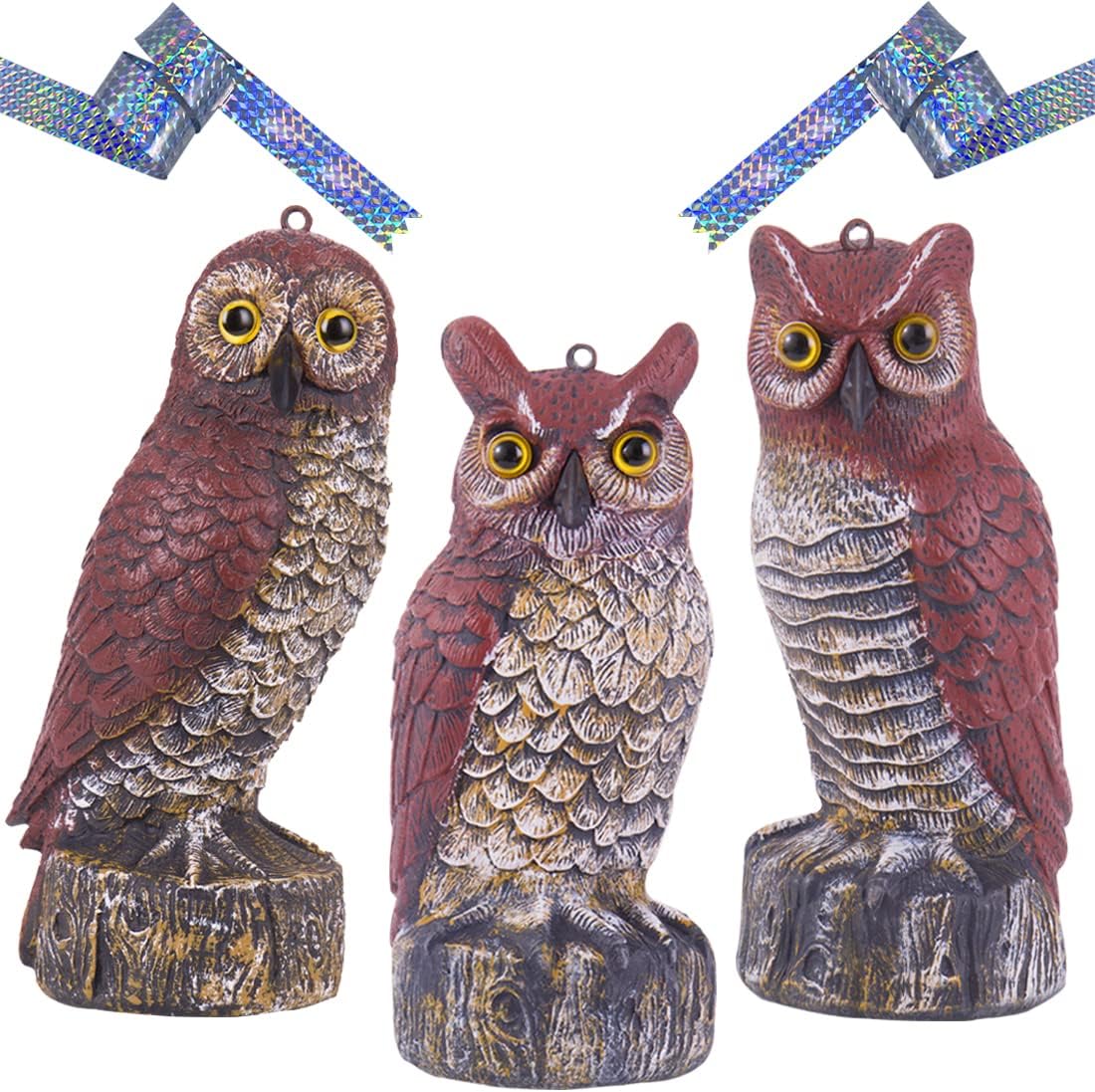
TaiBest 3 Pack Fake Horned Owl Statue With Reflective Tape |
|
This stationary 3-pack allows you to position owls throughout your property in varied locations. Hanging: Use the reflective tape with the built-in hanger between the ears. Flat surface: Fill the bottom with sand or gravel for stability. Post mounting: Slide the owl onto a post. These options enable more natural positioning. If you don’t use all the reflective tape for hanging, let it sway in the breeze as an additional bird deterrent. |

Bird Scare Owl, 4 Pack Plastic Hanging Reflective Bird Scarer |
|
This hanging owl decor is reflective and flaps in the wind to deter birds with its owl picture, jingling bell, dangling reflective tape, and shiny backside. The owl image is stereoscopic, creating the illusion of movement. For best results, use in a sunny area suspended from a tree branch or pole where it can catch the breeze and sunlight. |
How To Use Fake Owls To Scare Birds
It’s important to understand that fake owl decoys are only somewhat effective and must be moved every couple of days. Even with motorized moving heads, birds may eventually recognize the consistent, predictable movement as non-threatening over time.
To maximize the effectiveness of fake owls for bird deterrence, try the following strategies:
-
Position Owls in Natural Settings
Owls rarely sit in the open during daylight hours. They typically hide and roost close to tree trunks, within tree branches, and inside tree cavities. At night, they emerge to perch on utility poles, fence posts, rock piles, and hay bales. Placing a faux owl on a ledge or rooftop during the day is unlikely to fool birds. Instead, position the owl near trees and shrubs during the day, then move them to open areas at night. -
Change the Owl’s Position Frequently
Move the owl to a different location every few days—or even daily if possible. You can also rotate it to face different directions. This prevents birds from becoming acclimated to what they recognize as a stationary, non-threatening object. -
Use Multiple Owls & Complementary Strategies
Ideally, deploying several owl decoys in different locations will be more effective than using just one. Even better, choose decoys that combine movement, lights, or sound—unpredictable elements that are more startling to birds. Implement additional strategies such as bird-repellent sprays using vinegar and chili peppers, hanging old reflective CDs or DVDs, installing wind chimes and pinwheels, and removing bird feeders and birdbaths.
Keep in mind that owl decoys don’t work against all bird species. For example, while pigeons are natural prey for owls, they often seem undeterred by fake owl decoys. Homeowners and business owners frequently need to employ other tactics, such as bird spikes, to prevent pigeons from roosting.
Conclusion
Fake owls can be an effective tool for scaring birds away from your property when used correctly.
However, keep in mind that they aren’t effective against all bird species, particularly pigeons. Often, combining owl decoys with other scare tactics—such as offensive odors, reflective materials, and disruptive noises—yields the best results.
If you’re unsure about the best approach for your situation, consider consulting wildlife management resources or contacting professional bird control services. They can investigate the source of the problem and offer humane solutions for deterring birds without causing them harm.